Care, intimacy, and possessiveness blurred boundaries
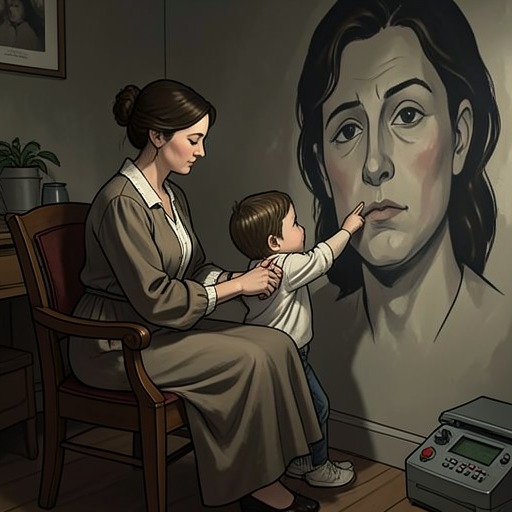
Chanson douceThe blurred boundary between care, intimacy, and possessiveness is a recurring pattern in Louise’s relationships with children. She can be patient, attentive, and indispensable in daily life; she can also turn closeness into a test of dependence, or imagine that a child should secure her place in a family. The novel develops this tension through contrasting scenes: the children’s distress when Louise vanishes during hide-and-seek, the household work through which she becomes almost invisible, Mila’s frightening separation from her mother, and Hector Rouvier’s adult memories of the nanny who once comforted him. Care is genuine in these episodes, but it does not by itself guarantee that the child’s needs, boundaries, and freedom will be respected.
Care as an Unequal Relationship
Louise’s work for Myriam’s family makes her intimately involved in the children’s lives while leaving her in a subordinate position within the household. One evening, after Myriam tells her she can leave, Louise continues tidying the bathroom, folding towels, emptying the washing machine, and preparing the children’s beds. She then takes a saucepan from the kitchen and begins making dinner. When Myriam tries to take it from her, Louise gently pushes her back and urges her to rest and spend time with her children. She promises that the children will be fed and that Myriam will hardly notice her presence.
That promise describes both Louise’s skill and the terms of her place. As the weeks pass, Myriam increasingly leaves tasks to her; she no longer calls to announce that she will be late, and Mila stops asking when her mother will return. Louise becomes indispensable by doing more, yet the work is framed as a kind of disappearance. The household’s ease depends on her labor, while the intimacy created by that labor does not erase the distance between employee and employer. The novel thus presents care not simply as affection, but as action carried out within an unequal relation of responsibility and dependence.
Games That Turn Dependence into a Test
Louise’s favorite game with the children is hide-and-seek, but it has neither counting nor agreed rules. Without warning, she disappears into a hiding place from which she can watch the children search. She keeps still and holds her breath; the game’s first principle is surprise, not a shared understanding of when it begins or ends.
Mila and Adam initially respond with excitement. Mila calls out and claps, while Adam laughs so hard that he falls. But Louise does not answer when they call for her. The play changes as the children become frightened: Adam cries, and Mila begins to believe that Louise has truly left them alone in the apartment and will not come back. Louise remains hidden as their distress grows, watching rather than reassuring them. The narration compares the children’s panic to the helpless struggle of a fish out of water, making the imbalance in the game plain: Louise knows it is play, while the children experience the possibility of abandonment.
Mila gradually learns to search more effectively, pulling open doors, lifting curtains, and looking beneath the bed. Louise responds by finding new hiding places, including the laundry basket, a cupboard, and the dark shower stall. Even when Mila searches in vain and cries, Louise does not emerge. A game that might have offered shared pleasure becomes a repeated test of whether the children can find the adult on whom they depend—and whether their fear can make her return.
Comfort, Reassurance, and Possessive Closeness
The novel also shows Louise providing real comfort. In Hector Rouvier’s recollection, she was patient with his nighttime fears, unlike his mother, Anne Rouvier, who sometimes lost patience when he asked for another story, water, or permission to leave the door open. Louise told Hector that she too was afraid of falling asleep. She accepted his fear rather than dismissing it, stroked his temples, and persuaded Anne to leave a lamp on so that the child would not have to endure such terror.
Yet Hector’s memories of tenderness are not uncomplicated. He remembers the physical closeness of Louise’s care more vividly than her face: her hands, her touch, and the way she kissed him. He recalls that her affection could carry an intensity he later understood as a desire to possess him entirely. The adult perspective holds comfort and unease together instead of treating one as proof that the other was absent. Louise could soothe a frightened child; the same closeness could also feel consuming, and Hector’s dependence left him little ability to name or judge the relationship at the time.
Her departure, years before the events involving the Massé family, reveals another consequence of such intimacy. Hector missed her intensely and resented the student who replaced her. He also felt unable to ask why Louise had left or to grieve openly: even at eight, he sensed that others might consider his attachment ridiculous. The bond had mattered deeply to him, but it did not give him any say over its ending. Its tenderness was real, and so was its asymmetry.
From the Family’s Caretaker to a Claim on Its Future
Louise’s care for Mila and Adam likewise moves between service and a claim to closeness. After Mila has been separated from Louise, the child rushes back to her, and Louise holds and comforts her. Once the other woman has gone, however, Louise tightens her embrace despite Mila’s request to stop. She warns Mila never to wander away again and tells her that a stranger might take her and keep her from her parents. The reassurance that follows the child’s return is therefore mixed with fear and control: Louise’s protectiveness is expressed through a frightening account of what could happen if Mila leaves her.
Neither tells Myriam that evening about the separation or Mila’s bite during the encounter. Their silence creates a secret shared between them, but it is founded on a conflict rather than mutual ease. They have each been hurt, and the concealment binds them without making the relationship balanced. The episode shows how an intimate bond can become more exclusive precisely when open communication with the parent is withheld.
Louise’s imagined future for the family makes the possessive dimension more explicit. While lying beside Hervé, she thinks of a newborn who would pass between her arms and those of Myriam and Paul, binding them together and repairing their misunderstandings. The fantasy gives Louise a place at the center of a renewed family life. The next day she asks Mila whether she would like a baby brother or sister and hopes Mila will carry the suggestion to Myriam. When Myriam laughs off the prospect of another pregnancy, Louise interprets the response as concealment rather than accepting it as a refusal.
The desire grows into a fixed explanation for Louise’s place in the household. She believes that another child would protect her position when Adam starts school and the home becomes emptier. She also comes to regard Mila and Adam as obstacles to the couple’s having a baby, blaming their demands and Adam’s light sleep for keeping Myriam and Paul apart. The care Louise performs for the existing children thus coexists with a fantasy that they must make room for a new child who would secure her belonging. The novel presents that progression as a dangerous collapse of the distinction between what Louise wants for the family and what the family members themselves want.
Intimacy Without Equal Power
Across these relationships, closeness is not treated as a simple measure of affection. Louise’s domestic work brings her into the most private routines of the Massé household; her patience helps Hector through fear; and her presence becomes a source of comfort to the children. But these forms of intimacy take place across unequal positions. Children depend on adults for safety and reassurance, while a nanny’s access to family life does not make her a parent or give her control over the family’s future.
The repeated tension between being needed and being allowed to belong gives the concept its force. Louise’s care can sustain other people, but she also uses proximity to watch, frighten, hold, or influence the children. Hector’s memories show how affection may remain precious even when its intensity is difficult to understand; Mila’s experiences show that a child’s fear or resistance cannot be treated as proof of consent. In this way, the novel distinguishes attentive care from possessive attachment not by denying their overlap, but by showing the consequences when the caregiver’s need for closeness takes precedence over the child’s security and agency.